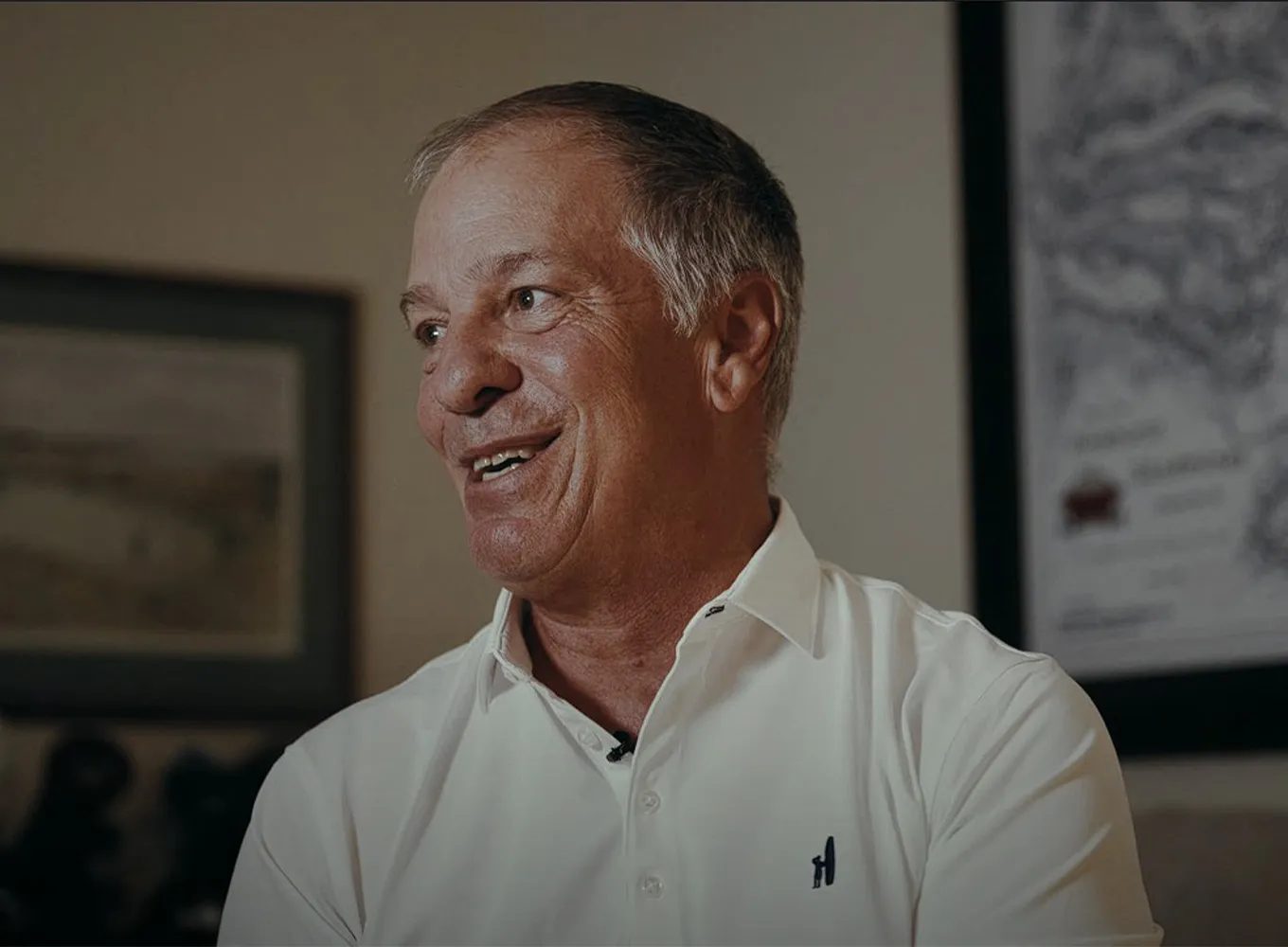
Tom Doak has worked from one idea since 1989: the land should do most of the talking.
Tom Doak grew up in Connecticut, studied landscape architecture at Cornell, and spent a year on a scholarship walking the great courses of Britain and Ireland, caddying at St Andrews to pay his way. What he saw there, courses that sat on the ground rather than on top of it, has shaped every project since.
After an apprenticeship with Pete Dye, he set up his own practice in Traverse City, Michigan. Doak Golf builds a small number of courses at a time, with the same crew of shapers moving from site to site, so that the people drawing the plans are the same people running the bulldozers.
Alongside the design work, Tom has written about golf courses for four decades. The Confidential Guide to Golf Courses, first published in 1996 and now a five-volume set, introduced the Doak Scale and remains the most candid guide to the world's courses in print.
- Practicing since
- 1989
- Based
- Traverse City, Michigan
- Principal
- Tom Doak
Theory
Exploration
The routing of a course is a guided tour of the property, taking the golfer to 18 designated spots, and showing her what we want her to see.
Terrain
Golf course design is about fitting golf shots to the topography and the features of the land. Golf is a three-dimensional game, and undulating terrain provides interest to the golfer’s stance and ball flight, as well as interest once the ball lands.
Variety
The greater the variety of golf holes, golf shots, and scenery, the more interesting the course.
Asymmetry
The natural landscape is not symmetrical. An imbalanced placement of hazards or an offset fairway creates visual tension that weighs on the golfer’s mind.
Composition
Just because features are imbalanced doesn’t mean they can’t combine in a beautiful way. When a golf hole looks exciting, it should prove exciting to play.
Harmony
We aim to leave nature as we found it, or at least to erase our footprints so that the course looks like it has always been there. The animals that grazed the early links did not leave mowing lines.
Services
Start a conversationConsulting
It’s essential to stay healthy and happy to be at my creative best, and I’m lucky to have more opportunities than time to pursue them. But I like to have a look at interesting projects, even when the budget is limited, and I’m happy to recommend someone for the job, if it doesn’t make sense for me.
The most valuable consulting I do now is on my first visit. Did the site for Tara Iti really have the potential to be a top 50 course? Could we maintain a world class course in St. Emilion, France, without well water? How big did the scope of a renovation at The National need to be, in order to bring the Ocean Course up to standard? I’ve spent forty years around the best courses in the world, and I know what it takes to get there.
Over the years, I have served as design consultant on some of the best courses in the world, generally with an eye toward restoration. Today, I have handed over most of those opportunities to my associates. I don’t mind going back to play Royal Melbourne or Bel Air every so often to check up on them, but when I have time, I’d prefer to help other courses get on the right track, providing a second opinion on where the priorities lie, or a master plan for one of my associates to implement.
Routing
Minimalist design is all about putting golf holes in the right place to utilize the natural contours of the ground. This makes routing the most valuable part of the process — because if you get the routing right, the course will cost far less to build. Some of my most highly rated designs — including Pacific Dunes, Barnbougle, and Ballyneal — are among the least expensive projects I’ve built. Then again, minimizing construction is even more valuable when you’re working in difficult terrain, like Stone Eagle.
There is no telling how many site visits and iterations it may take to find the best solution to the puzzle, but I charge a flat fee for routings, because the end product is all that counts. And I won’t allow a golf course to be marketed as my design, unless I did the routing.
For a much more in-depth look at the topic of routing, you’ll find none better than my new book, Getting to 18.
Supervision
Construction is a grind, but it’s the essential work of getting a great course into the ground. Many architects try to position themselves as professionals “above” construction work, but I’m never happier than when I am out on-site getting dirty.
I spend most of my time during construction working with the shapers as they sculpt the greens. Beyond that, I’m there as an editor to get that last 5% of detail just right, and get the course to play as good as it looks. If you’re trying for the top 100 lists, that bit is crucial. But not all clients need that level of oversight, so I am open to limiting my responsibilities here if the right people are in place to make those decisions.
A 0-to-10 rating of how far out of your way a course is worth going. A 10 is worth a special trip from anywhere in the world. A 0 is a course so contrived and unnatural it may poison your mind.
Cast and crew
The notion that the architect has dreamed up every last detail of the course before it’s built, is a fallacy. One thing I learned from Pete Dye was that the course continues to get better the more you work on it. To that end, I have always surrounded myself with talented people who can help make the golf course better while they are helping to build it.
First on the list are my associates. Brian, Brian and Eric have taken turns as lead associate for all of my projects since 2010, and have shaped most of the greens I’ve built since 2001. But we all value the input of our younger associates as well. Being open to good ideas is how you get better.